An Oral History of GamesFirst!
Voices from the Archive, 1995–2007
I. Genesis: The Dawn of the Web (1995–1998)

GamesFirst! was born in the mid-1990s, alongside the web itself. In 1996, the site was listed on NCSA’s “What’s New” page—a remarkable early web honor, back when being catalogued by hand was how you got found online. The early years were dominated by PC gaming, and the writers who would define the magazine’s voice were already opinionated about what made games matter.
Duke 3D is one good-looking game. It can be a little cartoony, but the smooth graphics, great lighting effects (including a dance club that’s as disorienting as the real thing), and relentless attention to the small details gives the game a strange aura of realism.
— Rick Fehrenbacher, Duke Nuke’em 3D, 1996
As I write this, Quake, the next big thing in 3D games, has just been released, and already some are sounding the bell for poor old antiquated Duke. That would be a mistake. Duke is a great game.
— Rick Fehrenbacher, Duke Nuke’em 3D, 1996
Rick Fehrenbacher wasn’t afraid to challenge the industry’s sacred cows when he thought they deserved it.
For some reason, id Software has sequestered itself in a curious evolutionary deathmatch dead end, from which it pumps out ever-improved versions of very much the same game over and over again. Welcome to Quake III Arena: The Prettiest Dinosaur.
— Rick Fehrenbacher, Quake III, 1997
Half-Life Changes Everything
Every so often a game comes along that pushes a certain genre’s bar a good bit higher, overshadowing all that went before it. This doesn’t happen all that often; though games often excel in one specific area, rarely does one put all the little details together just right. Half-Life is such a game; Valve’s designers got almost everything—and everything important—right.
— Rick Fehrenbacher, Half-Life, 1998
In Half-Life you take the role of Dr. Gordon Freeman, a scientist at the Black-Mesa Research Facility. One of the great joys of Half-Life is that you play Just A Regular Guy. No Dukes or Blades here, just a geek with a gun and whatever wits you can manage to keep about you during this wild, wild, ride.
— Rick Fehrenbacher, Half-Life, 1998
Half-Life’s levels also capture the same ‘epic feel’ that Jedi Knight did; the game’s scale is sprawling, and it tends to make you feel a bit insignificant. The game’s realism factor is impressive as well; the towering structures, bleak outdoors scenes, and leaking radioactive waste make you feel like you actually are at a nuclear and biotechnology research facility somewhere in the arid Southwest.
— Rick Fehrenbacher, Half-Life, 1998
New Management
In 1998, GamesFirst! changed hands. The founders moved on to real life, and two University of Idaho professors took the reins:
Hello There Ladies and Gentlemen. As you know, Games First! is under new management now. Al Wildey and I have purchased the site from our good friend and longtime compatriot Zap Riecken, who in this last year has married, relocated, and begun a new career. In other words, he got a life.
— Rick Fehrenbacher, Editorial: Welcome to GamesFirst! 2.0, 1998
We both love games and gaming—we’ll play just about anything anywhere. And we hope to communicate that enthusiasm in the pages of Games First!. We know we’ve got a big pair of shoes to fill (actually, only metaphorically — Zap’s a real, real, little guy, like 4’2" or something, and his feet are tiny), and we only hope we can continue the good work that Zap did. He took this magazine from nothing to an award-winner in his four year’s tenure as editor.
— Rick Fehrenbacher, Editorial: Welcome to GamesFirst! 2.0, 1998
II. 9/9/99: The Dreamcast Arrives (1999–2000)
On September 9, 1999, the Dreamcast launched with more titles than any console in history. GamesFirst! was there on day one.
This is one of those times when Chuck D. isn’t the guy to listen to, and you had better believe the hype.
— Shawn Rider, Dreamcast, 1999
Sega’s presence was overwhelming at E3. Their area hosted dozens of play kiosks, and game developers proudly displayed their DC titles in development all over the expo. The interest in Sega’s product was not spurred on by the desire to see the bloated carcass of an industry has-been. On the contrary, the DC screens were just plain impressive, and the oddly comfortable, spacecraft-shaped, controllers beckoned to the crowd.
— Shawn Rider, Dreamcast Hype, 1999
Sega has been on the cutting edge as long as they’ve been a company, and they aren’t letting up now. The Dreamcast is another step in the evolution of consoles, and it’s not surprising that Sega is once again leading the way.
— Shawn Rider, Dreamcast Hype, 1999
Sega is starting off on the right foot with more game titles (18 in the stores on 9/9/99) released on the launch date than any other system in history. I remember when the Nintendo 64 debuted agonizing over which of the few games I was going to buy. Now the decision is even tougher.
— Sarah Wichlacz, Dreamcast Hitlist, 1999
For some, the Dreamcast represented more than just a new console. It was a lifestyle choice, a commitment, an emotional investment.
Buying another console is like having another child. You don’t love one less just because you have a new one. You find room in your heart to love them both, and this is what I’m advising.
— Jeff Luther, Why You Didn’t Buy a Sega Dreamcast, But Should, 2000
The Dreamcast brings the internet to people who may not have had access to it before, due to the prohibitive cost and perceived complexity of computers. It is even more astonishing to think that half the population of the US isn’t involved in the computer revolution.
— Shawn Rider, Dreamcast, 1999
Although the Dreamcast had an enormously successful launch, no one was injured, and the thing went down as a final note on network news magazines. I didn’t even order a DC until the day before the ship date, and I was near the top of the list.
— Brandon Hall, Why You Should Pre-Order Your PS2 Now, 2000
Grrrl Gamez: A Voice for Women in Gaming
While the gaming industry struggled with representation, Sarah Wichlacz cut through the noise with an incisive editorial about women and gaming culture. The stereotypes were outdated, she argued—it was the marketing and advertising that was the real problem.
I decided that it’s not the games or the gamers that are the problem, but the damned video game advertisers along with a strong dose of our cultural stereotypes.
— Sarah Wichlacz, Grrrl Gamez, 1999
According to an IDSA press release, we make up 35% of console gamers and a whole 43% of PC gamers, and at E3 almost every booth had an equal number of men and women.
— Sarah Wichlacz, Grrrl Gamez, 1999
The problem isn’t that girls don’t game, it’s that the advertisement of games is equally sexist towards both men and women. Men are portrayed as either ultra-cool or ultra-pathetic nerds, and women are portrayed as ultra-cool or ultra-pathetic sluts. In fact, the advertising of games has a sort of equal opportunity sexism that seems to know no bounds.
— Sarah Wichlacz, Grrrl Gamez, 1999
E3 can do better. Next year I want to see some man booty out there too. If they’re gonna sell games to women by making us look like bimbos, they can do the same for men.
— Sarah Wichlacz, Grrrl Gamez, 1999
Years later, Laurie Taylor brought an academic lens to the same questions Sarah had raised. Her reviews of girl-positive games and her advocacy for diversity in game design pushed the conversation forward.
Problems which include the lack of diversity in game designers and in game characters, and the lack of young girl players—girls who could play games and become more interested in technological and science-related fields where girls are still heavily underrepresented.
— Laurie Taylor, Degrees in Game Design Help Gamers and Nongamers, 2005
Peach is a hardcore fighter while being hardcore girly and—while I’m not and never have been a girly girl—I love Peach for being true to her girly girl roots and for being tough enough to defend herself and her friends. Feminism celebrates multiplicity, the ability to be more than just a stereotype, and the ability to defy stereotypes in general.
— Laurie Taylor, Super Princess Peach, 2006
Nancy Drew has always been smart and capable and Her Interactive’s games continue Nancy’s classic personality. Games and their complementary websites like these are precisely what gaming needs to make ‘girl gamer’ into a redundant term.
— Laurie Taylor, Nancy Drew: Danger by Design, 2006
The Birth of Online Worlds
When all is said and done, however, the thing about Everquest that makes it truly revolutionary is the sense you get of being in a non-linear, ever-expanding world. There’s no real way to ‘win’ the game—the point is to explore, learn, and survive. We know this game isn’t life, but it’s a lot like it.
— Rick Fehrenbacher & Al Wildey, EverQuest, 1999
The game also includes a large number of communication options—you can shout, speak out of character, talk only to the members of your group or guild, or just to a specific individual. Communication remains important even at the highest levels of play; you’re always learning something new in EQ, and the information you garner from the online community makes possible a rewarding sense of discovery that extends well beyond the newbie stage. Make no mistake; Everquest is a very social game.
— Rick Fehrenbacher & Al Wildey, EverQuest, 1999
This frequently leads to the ridiculous sight of several groups parked outside a known spawn point, each politely taking turns killing the spawns.
— Rick Fehrenbacher & Al Wildey, EverQuest, 1999
Phantasy Star Online proves that online role-playing games don’t need to be complicated to be fun. The Dreamcast connection can be slow, and the gameplay is simplistic, but when you’re online with a group of people tackling a quest together, none of that seems to matter.
— Matt Baldwin, Phantasy Star Online, 2001
SEGA ensured that there would be no language barriers by building a rather unique real-time translation engine, which makes it easier to organize parties to move through each room.
— Matt Baldwin, Phantasy Star Online, 2001
Before Dark Age of Camelot, I had hit the massively multiplayer online role playing game wall. I’d burned out on EQ when it became apparent that week-long camps were a fact of gaming life at the higher levels. There’s nothing like planning with your guild, unlimbering some siege machinery, ambushing some unwary Hibernians in their frontier, and taking an enemy fortress. It’s one of the best gaming experiences I’ve ever had.
— Rick Fehrenbacher, Dark Age of Camelot, 2001
When Blizzard tells me they’ve got something up their sleeve, one thing goes through my mind: they haven’t missed yet, not once. They have an unbroken track record.
— Aaron Stanton, Preview: World of Warcraft, 2002
The Beautiful Disaster
Some games arrived with more hype than they could possibly deliver. The hubris of their makers became as legendary as their failure.
Playing through the first act of Daikatana is astonishing, like watching your future brother-in-law show up to meet the folks drunk. It’s taken four long years for the game to make it to the table, and during that time Ion Storm built themselves a pleasure-dome in Dallas and embarked upon a PR campaign that redefined the term hubris.
— Rick Fehrenbacher, Daikatana, 2000
Daikatana is the most disappointing game of the century. And trust me, I’ve played some bad games.
— Rick Fehrenbacher, Daikatana, 2000
I’m stuck playing a game that isn’t any fun, with NPCs that annoy me, in levels that just drag on and on.
— Rick Fehrenbacher, Daikatana, 2000
The Bouncer is what would happen if you took a movie that would be cool and condensed it into a game, but forgot to include the stuff that makes it a game. It’s a movie that’s under three hours and costs fifty dollars to watch.
— Jeremy Kauffman, The Bouncer, 2001
Oni is a great melting pot where nothing really melted. It borrows from the best action games but never achieves anything close to greatness in any category.
— Al Wildey, Oni, 2001
Turok Evolution blows. Not in a good way.
— Jeff Luther, Turok Evolution, 2002
I expected Duke to finally break loose and show everyone how to make a cutting-edge first-person shooter. But as production deadlines slipped further and further into the future, the industry caught up and then surpassed Duke’s features before the game even shipped. Now Duke is just another outdated shooter that people buy out of historical curiosity more than anything else.
— Shawn Rider, Masters of Doom, 2003
It rips best-ofs from other games as casually as a confidence man rips off old ladies on the boardwalk.
— Chris Martin, First Impressions: Too Human, 2008
Arcade Perfection
The Dreamcast ushered in an era where home consoles could finally deliver the arcade experience without compromise. For a generation raised on pizza parlor cabinets and dwindling quarters, it was a revelation.
Straight from the arcade into the living room, Hydro Thunder hasn’t changed a bit. The only thing different on the Dreamcast’s version is the lack of a quarter slot.
— Sarah Wichlacz, Hydro Thunder, 1999
Crazy Taxi is one of those games that makes you say ‘I’ll just play one quick round,’ but has you ditching out on studying and staying up all night, even if you have a French test in the morning. One game is so short you can’t help but play another, and another.
— Sarah Wichlacz, Crazy Taxi, 2000
Crazy Taxi is like solitaire and Tetris in that you aren’t trying to beat the game, you’re trying to beat yourself. I’ve been spending my spare time thinking about faster routes to KFC, and it’s just like the good old days, dreaming of falling Tetris blocks.
— Sarah Wichlacz, Crazy Taxi, 2000
This is the most insane, bizarre, and ridiculously beautiful fighting game I have ever seen. Marvel vs. Capcom 2 is the high point in a genre that has not lacked high points. It delivers an unprecedented fifty-six characters for your slug-fest enjoyment, which is undoubtedly the most impressive line up ever established in a fighting game.
— Jeff Luther, Marvel Vs. Capcom 2, 2000
I remember a time when the name M. Bison would bring tears of frustration to the eyes of many an arcade patron as they made a mental tally of all the money they had lost to the cheating dictator of Shadoloo. Then Street Fighter II came home via the Super Nintendo and gamers let out their own evil laugh. By my calculations, M. Bison has been wearing his ass for a hat for about a decade now.
— Jeremy Kauffman, Street Fighter Alpha 3, 2000
The Worst Games Ever
Some games earned their place in infamy. GamesFirst! reviewers held nothing back when a game deserved it.
After several counseling sessions, a pint of Wild Turkey, and a week and a half of guilt debt, I still would rather do anything else.
— Brandon Hall, Spec Ops, 2000
If you have any enemies that you really want to get back at, wrap up this baby and send it to them.
— Al Wildey, Wild Wild West, 2000
I had played the game enough to know that I never wanted to play it again; however, I didn’t play it enough to be able to give it a fair review. All night I kept thinking, ‘I don’t want to play anymore. Please, don’t make me.’
— Jason Frank, Jeremy McGrath Supercross World, 2002
Maybe instead of bothering to release new games based on DBZ, Atari can just come to every DBZ fan’s house and take $30 or $50 and punch us in the face or something.
— Eric Qualls, Dragon Ball Z: Taiketsu, 2003
I started having dreams about that levitating platform and I would find myself trying to create a 3-D model of the ledges with my mashed potatoes. I didn’t like what the game was doing to me. I had to give it up.
— Jason Frank, Jedi Power Battles, 2002
III. The Console Wars (2000–2002)
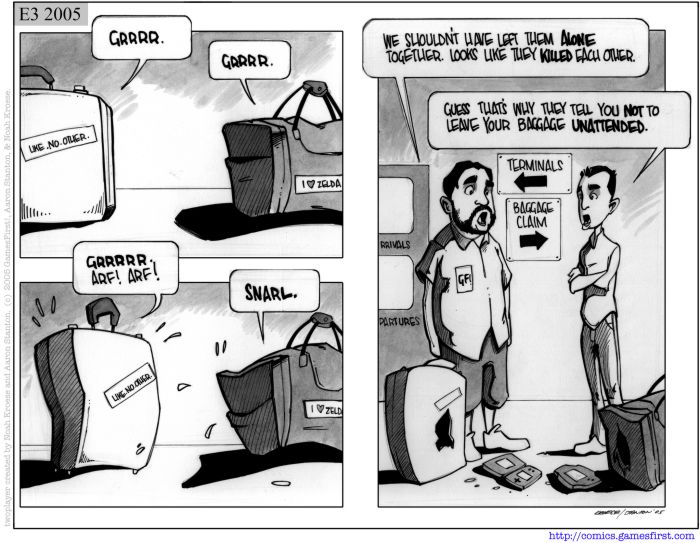
The new millennium brought three titans into battle. The arguments were passionate, technical, and personal.
PlayStation2, the words still sound like honey in my ears. Like the culmination of some grand epic, the PlayStation 2 is now a reality and I’m still giddy with excitement. My zealous desire to own a PS2 reached a fevered pitch this week and had me compared to everything from an irrational fanatic to a crack whore looking for a fix.
— Jeff Luther, Editorial: PlayStation 2 and the Future of Gaming, 2001
As a poor college student, laying down the money for a PS2 was a near mortal blow to my finances, but it was worth it all the way.
— Jeff Luther, Editorial: PlayStation 2 and the Future of Gaming, 2001
I may be eating rice and beans for the rest of the year, but I’m going to be eating rice and beans while playing the greatest videogame system to hitherto grace this fair planet.
— Jeff Luther, Editorial: PlayStation 2 and the Future of Gaming, 2001
But not everyone was convinced.
Xbox rules. The PlayStation 2 is simply an inferior system. It has inferior hardware, put together in a completely bizarre configuration with utter disregard for the standards that have arisen to govern computer system design.
— Shawn Rider, Xbox vs. PS2 Redux, 2001
I can smell a coming storm. Rain to wash away the blood from the coming battle.
— Matt Baldwin, Xbox Vs. PS2, 2000
The Art of the Machine
As three titans collided, the technical merits mattered less than what each platform represented about gaming’s future.
Just as a classic Mercedes Gullwing will always stand out from the crowd of other cars, certain games will represent a highpoint in gaming.
— Adam Albrec, Editorial: Getting Beyond the Third Dimension, 2001
It’s a little like a classic comic book. The illustration might not be as flashy as the ones on the stands now, but it represents a former ‘state of the art’ that the new was built on.
— Adam Albrec, Editorial: Getting Beyond the Third Dimension, 2001
Never before have three companies as capable as these all gone to the mat, and with such arguably great products. On one side is the PS2—a machine made to make the most of the “here and now” in the way that Sony does best. In the middle, there is Nintendo’s GameCube that offers a splendid balance in-between at a lower price-point. X-Box easily shows the most promise from a technical standpoint. Quite possibly six times as powerful as the next guy. But the world’s most powerful software company doesn’t have experience in the console industry. Is this a problem?
— Adam Albrec, Three the Hard Way, 2001
Halo Arrives
In November 2001, the Xbox launched with a game that changed everything.
This game rules. I can’t believe how cool it is. Those textures—from a distance they look like regular textures, like on PS2 or something. But up close each bit of metal has scuffs, the rocks look rough, and I can see individual blades of grass on the ground.
— Shawn Rider, Notes Scribbled in the Dark While Playing HALO, 2001
There are no fog walls. The sky is way off in the distance and it feels real, not plastic and fake. I keep expecting to see a mountain range or something equally grand and foreboding.
— Shawn Rider, Notes Scribbled in the Dark While Playing HALO, 2001
There are these shadow animals that move along the ground when you walk past them. They move out of the way. That’s freaky. Nothing in any game has done that before.
— Shawn Rider, Notes Scribbled in the Dark While Playing HALO, 2001
The GameCube Underdog
Nintendo’s little purple machine had something neither Sony nor Microsoft could offer: pure games.
At $199 it is $100 cheaper than the Xbox and PS2. Kind of makes you wonder why you paid $299 for a PS2, doesn’t it?
— Aaron Kauffman, Nintendo Gamecube: The Little System That Could, 2001
Eternal Darkness is a game that knows you are playing it and seeks to return the favor.
— Jeff Luther, Eternal Darkness: Sanity’s Requiem, 2002
The general consensus here at GamesFirst! is that the GameCube will surprise a lot of people with the quality of its library.
— Aaron Kauffman, Nintendo Gamecube: The Little System That Could, 2001
PCs and consoles are different… Console gamers, on the other hand, take their PlayStation 2s to the local videogame store to pay 15 bucks for some counterjockey to blow out the dust so the machine will quit skipping. Console gamers just don’t want to be that bothered with the technology—they don’t want to install patches, tweak settings, or work to play the game.
— Shawn Rider, The Console Wars Go Online, 2002
Unless you own all three systems, you’re going to miss out on something great. The best advice I can give you right now is to buy a different system than your best friend—and then share. Diversity of platforms will serve us all.
— Shawn Rider, Which Console Should I Buy?, 2002
Violence, Games, and the Real World
We play games to do things we can’t do in the real world—driving big robots, scoring touchdowns, skating really good, sniping innocent civilians. Playing the game allows you to indulge the fantasy without the ramifications of the reality.
— Shawn Rider, I Am God Editorial, 2002
People who think they are gods and murder other people are serial killers or paranoid schizophrenics, not gamers—there’s a significant difference there, and we need to recognize that.
— Shawn Rider, I Am God Editorial, 2002
The bus driver may not have been paying attention because he was tired, or because he was thinking about his wife, or because a bird flew into his window. Games don’t cause violence any more than watching a movie, reading a book, or having a bad day at work causes violence. Context-sensitive buttons don’t commit crimes; people do.
— Jeff Luther, The Reality of Games, 2002
IV. On the Road: Events, Expos, and the Show Floor (1999–2007)
The Annual Pilgrimage
GamesFirst! writers didn’t just review games from their desks. They went places—E3 in LA, NAB in Vegas, the Asia Game Show in Hong Kong, Slamdance in Park City, E For All in its scrappy first year. These are their dispatches from the show floor.
What is E3? It’s nerds in their element; a gathering of the industry to celebrate our own coolness. It’s the biggest bash you will ever attend. It’s the ultimate proof that the shy fellow you pass in the hallway is the same one that’s going to someday be able to hire a modeling agency to cater his after-show parties.
— Aaron Stanton, The Truth About the Party Kings, 2003
Ultimately, it’s to suggest that the term ‘nerd’ is nothing more than another way of saying ‘future lord of the entertainment dance’ or ‘yet to mature party king’… We nerds are the kings of the party. We just haven’t realized it yet.
— Aaron Stanton, The Truth About the Party Kings, 2003
It was a shock to my system—seeing thousands of people, all excited about games, all celebrating what we love. The throbbing techno, the impossibly tall men and women, the lights and the glitz all started to overwhelm me.
— Sarah Wichlacz, Sarah’s E3 Photo Diary, 2000
E3’s an amazing institution, an enthralling yet weird combination of postmodern Japanese/American video culture and late capitalistic decadence.
— Rick Fehrenbacher, E3 Extravaganza!, 1999
My best moments at E3 had nothing to do with hype; they had to do with talking to design crews about their newest games and hanging out with a bunch of thoughtful and engaging people who were as into games as much as I was. There were a lot of moments like that—sitting around with the Tribes 2 design team talking about our Everquest characters, chatting with Warren Spector about Steve Jackson and living in Austin in the early 80’s, hacking around on AoE 2 with some kid from Pomona who called himself Black David. There’s no people like game people.
— Rick Fehrenbacher, E3 Extravaganza!, 1999
It’s hard not to feel damn cool cruising the world’s biggest free arcade.
— Shawn Rider, Shawn @ E3, 1999
This was my first E3 and I’m already fantasizing about going back next year. I had more fun in three days than I had in the rest of this year.
— Sarah Wichlacz, Sarah @ E3, 1999
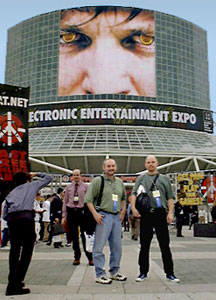
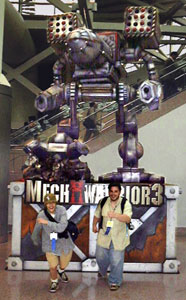
Everyone at E3 knows that an E3 party’s not an E3 party until the GamesFirst! crew and/or Ice-T arrive, and both of us made the Sega soiree, which thus qualifies it as a Significant Historical Event.
— Rick Fehrenbacher, Rick’s Best of E3, Part One, 2000
Even though Sega’s got to be daunted by disappointing Dreamcast sales, their party had an air of exuberant decadence about it that I could only admire. Whether this is confidence or just fiddling while Rome burns, time will tell, but it sure was fun.
— Rick Fehrenbacher, Rick’s Best of E3, Part One, 2000
I received a phone call from Monica Hafer here at GamesFirst! to come and meet with the creators of Galactic Civilizations. Immediately I dropped what I was doing—ogling the preview for Ghost Recon 3 for the second time—and blitzed for the doors, knocking over some game players as I weaved in and out of the crowd.
— Chris Martin, E3 2005: A Meeting with Stardock, 2005
Fatal1ty: The First Pro Gamer
At E3 2003, GamesFirst! sat down with Jonathan “Fatal1ty” Wendel, who was pioneering something that didn’t yet have a name: esports.
I got home, I put the check on the table, and I said, ‘Look at that, Mom and Dad. I made $4000 playing a computer game—what’s this world coming to?’ That was back in ’99.
— Jonathan Wendel, interviewed by Shawn Rider, Interview with Fatal1ty, 2003
This is like chess and sports in one. You have to have real stamina, not just physical stamina, but brain stamina. You have to bring that mental game, and that’s the most important thing in these tournaments.
— Jonathan Wendel, interviewed by Shawn Rider, Interview with Fatal1ty, 2003
The Open-Source Console That Never Was
At E3 2000, a startup called Indrema pitched a radical idea: an open-source Linux-based game console where anyone could develop and distribute games for free. It was years ahead of its time.
If we compare the games industry to the film industry of the 20th Century, the big guys, Sony, Sega, and Nintendo, can be seen as the Hollywood Studios, and Indrema could be the video game equivalent of the Independent Film Channel. Developers who don’t have access to scads of investment capital and scarce hardware tools cannot make games for the other console systems, but Indrema offers a solution, enabling virtually anyone with a PC to become an Indrema game developer.
— Shawn Rider, Interview: John Gildred, Founder and CEO of Indrema, 2000
We’re also offering a not-for-profit certification program, so if somebody wants to create a game that will pass the Indrema certification, and they want to let people have it for free, then we do not charge a royalty fee. So the next John Carmack could come from who knows where, but they will likely code it onto our system before anything else.
— John Gildred, interviewed by Shawn Rider, Interview: John Gildred, Founder and CEO of Indrema, 2000
Beyond E3
E3 was the biggest show in town, but it wasn’t the only one. GamesFirst! writers fanned out to cover events across the globe—from the broadcasting industry in Vegas to indie games at a film festival in Park City to a game expo in Hong Kong.
NAB stands for the National Association of Broadcasters, and the Vegas Convention Center hosts what is touted as the world’s largest electronic media show. It’s a much more subdued environment than E3. There are no explosions or rock concerts, and the notion of a “booth babe” is pretty much absent, which is probably a good thing because of this convention’s more “grown-up” nature and its dual-gendered business focus.
— Monica Hafer, Reporting from NAB in Vegas, 2006
What I discovered is that if I had enough time and money, I could single-handedly make my own film, edit it, and broadcast it to the unsuspecting masses. This is probably dangerous in the wrong hands, but I think that a girl has to have some goals.
— Monica Hafer, Reporting from NAB in Vegas, 2006
When 90% of your game exposition experience comes from events like E3 in California, it’s hard to know what to expect from a game show in Hong Kong. The problem with coming to an exposition in Hong Kong is that it’s difficult to quiz the people attending the booths like I would at an event where English is the native tongue. And “Press Packet” is not as universally understood as I had hoped.
— Aaron Stanton, AGS & DE Expo Asia 2005: The Expo That’s Not E3, 2005
Cosplay is much bigger here in Hong Kong than in the United States, and it’d be a mistake to assume that every person dressed up to resemble a character from Soul Calibur is being paid by a marketing company. Here, most of them seem to just be people doing it for fun, which I have to admit is sort of cool.
— Aaron Stanton, AGS & DE Expo Asia 2005: The Expo That’s Not E3, 2005
Slamdance, the indy film festival that runs opposite Sundance, will hold a Guerilla Gamemaker Competition this year—featuring well-known indy and art games such as Cloud and Façade. Slamdance will bestow an array of awards on the independent developers, students, and artists who have created some of the most unique games we’ve ever seen.
— Shawn Rider, Slamdance Guerilla Gamemaker Competition, 2005
When E for All was announced, I was extremely excited. Here was a nascent convention with a general audience focus on the common gamer, the people whose actual hard earned money fuels the industry. It gave me hope that there were still people on the business side of the industry who felt that it was important to have an event which welcomed the “unwashed masses.”
— Monica Hafer, E For All, 2007
Because the convention was limited to one hall, there was a mixing of large publishers with small, retailer booths rubbed shoulders with demonstrations of new gaming technology, and art had an uneasy truce with commerce.
— Monica Hafer, E For All, 2007
Booth Babes and the Problem of Misogyny
In 2001, Shawn Rider and Sarah Wichlacz decided they’d had enough. The documentary they made became a cultural marker of changing attitudes toward women in gaming.
At this year’s Electronic Entertainment Expo, we just couldn’t stand it anymore.
— Shawn Rider, Booth Babes: A Short Documentary, 2001
Imagine our surprise when we found women in semi-skimpy clothing outside the E3 Convention Center protesting the decision with signs that read, “Booth Babe Protest: I am rated ‘E’ for Everyone.” Imagine our even greater surprise when E3 security showed up during our interview to force them off the premises. Not for being in skimpy clothing, but for being protesters. In skimpy clothing.
— Aaron Stanton, Protesting Booth Babes Kicked Out By E3 Security, 2006
Metroid Prime: The Expedition
Metroid Prime isn’t a first-person shooter. It is an expedition on a hostile alien planet.
— Matt James, Metroid Prime, 2002
With arm cannon ready I entered a mist filled room expecting the worst. As I crept slowly inside my visor began to fog up! I was amazed; heck I stepped out and walked back in just to see it again.
— Matt James, Metroid Prime, 2002
When I reached the ice land I had to literally stop and just take it all in. I was struck by the vast landscape first. Looking out as the snow slowly drifted towards the ground. Then the music swept me up. I felt like I was participating in the most amazing movie I have seen in years.
— Matt James, Metroid Prime, 2002
Interview with Lord British
The kicker is that I also think the game was not designed well… People who play Final Fantasy games are used to grand cinematic, with a fairly simple, easy to play style… Final Fantasy XI isn’t doing as well as hoped.
— Richard Garriott, interviewed by Aaron Stanton, Interview: Richard Garriott (aka Lord British), 2002
E3 Is No More
It’s like seeing a brother get married. You know it had to happen, and you know that it’s the right thing, but you still feel the loss.
— Aaron Stanton, E3 Is No More: After the Shock, 2006
All you had to do was wander around for a while until a PR guy managed to hit you on the head with something mildly painful. That, and maybe the random celebrity appearances and interviews, are all I’ll really miss from the show itself.
— Aaron Stanton, E3 Is No More: After the Shock, 2006
Here at GamesFirst, I think we’ll miss the unifying element. Based out of two offices on opposite sides of the country, East and West, there are members of our crew that work together online on a daily basis, but never see each other outside of the annual E3 event. We’ll miss being reminded of how cool the people we work with really are.
— Aaron Stanton, E3 Is No More: After the Shock, 2006
V. Games as Art (2001–2007)
By the mid-2000s, some writers were making an argument that had seemed outlandish just years before: that games could be art in the same way that film and literature were art.
There are some books and films that make you want to linger. You’re less concerned with getting to the end than you are with soaking in all that you can… Ico is one of the few games that I’ve played where it didn’t matter all that much if I reached my objectives as long as I had enough time to take in my surroundings.
— Jason Frank, ICO Review, 2001
Ico is a work of art. Video games as a whole still have a ways to go before they can be judged alongside film and literature, but Ico is a step in the right direction.
— Jason Frank, ICO Review, 2001
In the most classic and richest sense, Final Fantasy X encapsulates the struggle between a domineering father and a strengthening son; only Kafka put to paper a better interpretation of this theme.
— Matt Baldwin, Final Fantasy X, 2002
The Medium’s Power
In 2000, Oddworld creator Lorne Lanning articulated what many game designers were beginning to feel: that the medium was more powerful than anyone had yet realized.
The game medium is the most powerful entertainment format ever to exist. The proof is simply in the number of hours that gamers spend in these simulated experiences. You could never produce a movie or play, or write a novel that demanded as many hours of an individual’s attention as many games have.
— Lorne Lanning, interviewed by Shawn Rider, Lorne Lanning Interview, 2000
As creators of consumer entertainment, and as people who believe in the power of this medium, we think it’s important that we view our content as art form and allow it to have the same level of social and political criticism that more classical forms of art and storytelling are afforded.
— Lorne Lanning, interviewed by Shawn Rider, Lorne Lanning Interview, 2000
In short, we do want to create experiences that are more than just junk food. As a global people we understand that persistence, empathy, cooperation, and the use of brains for problem solving are fundamental approaches to getting ahead in life and creating the type of world we all want to live in. So, why shouldn’t this theme be part of the video game experience.
— Lorne Lanning, interviewed by Shawn Rider, Lorne Lanning Interview, 2000
Pretty Colors and Lens Flare
I found myself paying attention to the light. I found myself looking for small reflections I could identify as tree and building. I could see the sky above reflected in the windshield. The flare-ups of light concentration highlight the curves of the vehicle body. It is very much like looking at a real car in real life, yet not at all, and what strikes me is that I’ve caught myself realizing this.
— Shawn Rider, Pretty Colors and Lens Flare: Why Graphics Matter, 2005
Add to the list of things videogames do for us: aesthetic appreciation. A study a couple summers ago concluded that action games enhance visual acuity—that is, FPS games made players better at detecting small movements and details in a scene.
— Shawn Rider, Pretty Colors and Lens Flare: Why Graphics Matter, 2005
With over $7.3 Billion at stake, the industry is loathe to take risks. And with a firm grip on a target demographic most industries pay through the nose to access, game publishers have little reason to try to expand their audience. It’s a classic example of the economics and rationale of the industry working against itself, just as we’ve seen in the music and film industries.
— Shawn Rider, Pretty Colors and Lens Flare: Why Graphics Matter, 2005
Love in Tamriel
I have an Orcish wife in Tamriel. Well, I call her my wife; I’m not sure what the common law marriage laws are like in Cyrodiil, and I can’t find anyone to marry us officially (yet). Her name is Mazoga, and she is my best friend… Ma-zo-ga: Light of my life, fire of my loins.
— Shawn Rider, My Oblivion Wife, or: Of Orcish Bondage, 2006
I never wanted to be your keeper. I wanted to be your equal, your partner in crime, your companion in the fight against evil—and against the boring mechanical systems that govern this world.
— Shawn Rider, My Oblivion Wife, or: Of Orcish Bondage, 2006
Super Columbine Massacre RPG
Super Columbine Massacre RPG is not a great game. But it is an important game. It is a game created by a filmmaker, not a game developer… This may not be the future of gaming, but it is a step towards the future of how games will be treated and viewed in our culture—as artful, meaningful objects which represent the thoughts, ideas, dreams and nightmares of a unique creator.
— Shawn Rider, Super Columbine Massacre RPG: Art or Atrocious?, 2006
Girls and Games
Girls and women who play casual games or other atypical games don’t necessarily have a way to bridge into other games or into technology in general. The Nancy Drew games by Her Interactive provide this bridge in a usable and enjoyable format.
— Laurie Taylor, Nancy Drew: The Creature of Kapu Cave, 2006
If people want less violent video games, then people need to study games and make new games or to study games and be able to suggest different methods of gaming.
— Laurie Taylor, Degrees in Game Design Help Gamers and Nongamers, 2005
Games as Refuge
Games weren’t always about winning or high scores. Sometimes they were about survival through difficult times.
Mainly I play games because they’re fun, but sometimes I play games when I’m stressed. You read about people that are using games to teach children things, or help people that are sick—and that’s great—but that’s not all that games do. Sometimes they can be an out for anyone. It’s like music or movies. On bad days, when you’re really worried, you just have to make it through, and games can help you do that.
— Janny Stratichuk, interviewed by Aaron Stanton, A Peak Behind Alice: One Woman’s Reasons for Gaming, 2005
Addicted
World of Warcraft was a phenomenon unlike anything gaming had seen before. It also raised an uncomfortable question: what happens when virtual worlds feel more compelling than the real one?
It’s two in the morning. My eyes are bleary, my shoulders are tired, and my mouth is parched. I’ve been hard at work in front of my computer for over four hours now without a break. My name is Garywong and I am hopelessly addicted to World of Warcraft.
— Gary Wong, Help Me! I’m Addicted to World of Warcraft!, 2005
At the height of my addiction, it would not be uncommon for me to log on at one o’clock on a Saturday afternoon and not log off until four o’clock Sunday morning.
— Gary Wong, Help Me! I’m Addicted to World of Warcraft!, 2005
VI. Next-Gen: Revolution and Reflection (2005–2006)
Nintendo Gets It
As the PS3 and Xbox 360 prepared for their debuts, Nintendo was quietly planning something radical.
It blows my mind that Nintendo has so effectively proven that they ‘get’ it. How so? The Revolution controller. What? Yeah, that magic wand thing probably is the future of gaming. And furthermore, in the ‘next-gen’ launch lineup it is starting to look like Nintendo is the only company that will deliver a truly next-gen gaming platform. Compared to the Revolution, the Xbox 360 and PlayStation 3 are simply expensive upgrades to existing platforms.
— Shawn Rider, Why Nintendo Gets It, or Why Sony Should Start Trying, 2005
Gamers care about hardware and hardware generations only insofar as those generations mark major changes in the way games are made and played. Gamers care about framerate only insofar as framerate is connected to the limit of a player’s reflexes.
— Shawn Rider, Why Nintendo Gets It, or Why Sony Should Start Trying, 2005
Next-Gen Skepticism
It’s starting to look like Sega’s demise forced the industry into a time-warp of nostalgic home console design. The Colecovision controller had all these buttons too.
— Chris Martin, Revolution and the Next Generation of Gaming, 2005
I despise EA’s philosophy. It has pervaded the industry like a virus, mutating it into a thing that is barely recognizable as the same organism it was only a few years ago.
— Chris Martin, Revolution and the Next Generation of Gaming, 2005
The Mobile Future
You have 180 million cell phones out there, and they all play games. Most of these users are not gamers, but they will pick up and play something that looks familiar. When you download Ms. Pac-Man, it looks like Ms. Pac-Man. There’s no false advertising.
— Scott Rubin (Namco Networks), interviewed by Shawn Rider, Namco Networks and the Future of Mobile Gaming, 2006
The Convergence
As the decade wound down, voices from the industry began predicting a future where all entertainment would merge into one platform. The vision was both prophetic and incomplete.
In five or ten years from now it is very likely that most of us will have a single set top box that allows access to all the entertainment we care about—this includes games—whether it is played locally or received over the air, over the Internet or via a closed cable/satellite/telco network.
— Ronen Mizrahi (TVersity), interviewed by Shawn Rider, The Future of Television: Games, Media and TVersity, 2006
I personally think that games will play a more significant role than ever and that social networking in games and in entertainment in general is the next big thing. While MMORPG are taking the first step into massive interactivity I think this is just the beginning and we are headed into a future where the collective actions of individuals will add up to a new kind of experience for the masses.
— Ronen Mizrahi (TVersity), interviewed by Shawn Rider, The Future of Television: Games, Media and TVersity, 2006
VII. The HD Era: Art, War, and Everything Between (2006–2007)
The Legend Returns
When Twilight Princess arrived, a generation of gamers finally got the answer to a question they’d been asking: could lightning strike twice?
Does Twilight Princess trump Ocarina of Time, a game many consider to be the best video game ever? In this writer’s opinion: absolutely.
— George Holomshek, Return of a Legend: The Legend of Zelda Twilight Princess Review, 2006
Gears of War: The Killer App
It has been a goddamn agonizing year of waiting for Xbox 360 owners. So we waited, helpless to the arduous pace of time. But luckily we have an understudy that’s worth every bit as much as Halo, maybe more. It might be the best game to hit any console this year.
— Chris Martin, Gears of War Review, 2006
What really gives Gears of War the notch up on other shooters is how satisfying everything is. From the grind of the chainsaw, to the way the guns sound and respond, right down to the squishy explosions of flesh. It’s all very satisfying and gory, which, perhaps, says something about our society’s preoccupations at large.
— Chris Martin, Gears of War Review, 2006
The Dark Side of Online Gaming
I love Gears of War. And I hate Gears of War. Epic’s shooter is a source of so many hours of joy and so many hours of frustration… But I can’t stop playing Gears, yet. It’s a love/hate relationship, you see.
— Chris Martin, Why I’m Selling Back Gears of War When Halo 3 Comes Out, 2007
I think the eight-year-olds who squeal at me about how much I suck and how much of a fag I am has caused psychological damage. What do I know? I probably deserved that shotgun blast to the face, that smoke grenade on my downed corpse, and all that constant flaming.
— Chris Martin, Why I’m Selling Back Gears of War When Halo 3 Comes Out, 2007
In Halo, I’m an island; I’m unpredictable. I’m a whirlwind of fucking guns and mayhem.
— Chris Martin, Why I’m Selling Back Gears of War When Halo 3 Comes Out, 2007
BioShock: A Masterwork
The last great game reviewed before GamesFirst! went silent was a game that proved the writers’ decade-long argument: games could be art.
BioShock is, simply, a masterwork.
— Chris Martin, BioShock Review, 2007
And then there are those moments in the game where you know you’re playing some sort of higher art.
— Chris Martin, BioShock Review, 2007
BioShock is a single-player only experience and is nothing without the narrative, without the bread-and-butter story that trumps not only every other game this year, but perhaps even every film this year.
— Chris Martin, BioShock Review, 2007
The GamesFirst! Weekly Wrap-Up
In 2005, GamesFirst! launched a podcast—the GF! Weekly Wrap-Up, hosted by professional radio DJ Val Townsend, “the Atomic Goddess.” It was a polished, fast-paced news roundup drawing from the magazine’s reporting, not a casual chat show.
Welcome to the new GamesFirst! Podcast. I’m Val Townsend, the Atomic Goddess, and I’ll be your host for a weekly wrap-up of the latest in gaming news, reviews and previews from GamesFirst.com.
— Val Townsend, GF! Weekly Wrap-Up, Episode 1, 2005
The camera moves as if it were taped to the back of a drunken fruitfly, and for a game based on a cartoon based on pretty much nothing but fighting, the combat system here is just plain bad. We’ve rarely seen Power Levels so low.
— Val Townsend, GF! Weekly Wrap-Up, Episode 1, 2005
VIII. Coda
In 2007, GamesFirst! went quiet. The last articles trickled in—a BioShock review here, a Halo 3 prediction there. The writers had jobs, families, graduate degrees to finish. The site had always been a labor of love, run by people who believed games were worth writing about seriously. From a listing on NCSA’s “What’s New” page in 1996 to nearly 2,800 articles spanning 12 years, GamesFirst! documented an industry that grew from a hobby into a cultural force.
We probably don’t even have to publish this review, because World of Warcraft is a game that carries its own legion of fans. If you were able to pull away from the addictive qualities World of Warcraft possesses for many… The Burning Crusade will pull you back in. Install with caution… oh, who am I kidding? Just install it.
— Amanda Bateman, World of Warcraft: The Burning Crusade, 2007
Undertow is what Xbox Live Arcade needs more of: a simple premise with perfect execution and excellent multiplayer through Live. Chair Entertainment’s Undertow is a work of pure quality, one of those diamonds waiting for arcade gamers to dig up and discover.
— Chris Martin, XBL Arcade Review: Undertow, 2007
The play’s the thing.
This oral history was assembled entirely from the words of GamesFirst! writers and their interview subjects. No new text has been added. Each quote links to its source article in the GamesFirst! archive.
Writers represented: Rick Fehrenbacher, Shawn Rider, Sarah Wichlacz, Jeff Luther, Jason Frank, Aaron Stanton, Matt James, Chris Martin, Gary Wong, Amanda Bateman, Monica Hafer, Adam Albrec, Matt Baldwin, Al Wildey, George Holomshek, Jeremy Kauffman, Aaron Kauffman, Brandon Hall, Eric Qualls, Laurie Taylor
Podcast host: Val Townsend
Interview subjects: Richard Garriott, Lorne Lanning, Jonathan Wendel, John Gildred, Scott Rubin, Ronen Mizrahi, Janny Stratichuk